


Frequently Asked Questions
Find answers to commonly asked questions below.

So what does pigeon proofing solar panels cost? It depends on how much of the job you do yourself. Doing it yourself with a mesh kit starts at about $100 for a 30 metre kit. Paying a professional is quoted at anywhere from a few hundred dollars to about $2,000, depending on whose figures you read and how big and awkward your roof is.
That's a wide spread, so this guide breaks the cost down: what you're actually paying for, what pushes the price up, how a DIY job works out on a real example, and when it makes sense to hand it over to someone else. Prices here are a snapshot and they'll change, so treat them as a guide and check before you buy.
The cost comes down to how much perimeter you need to close off, how hard it is to get to, and what's already living under your panels. A small array on a low roof is a different job from a big array on a steep double storey.
The mesh itself is the smaller part of the bill. On a professional job, most of the price is labour, roof access and clean-up. On a DIY job, it's mostly the mesh and clips, plus your time.
Pigeons are the main reason people look into this, but they aren't the only reason it's worth doing. The warm, sheltered gap under panels draws in birds, and rodents can follow them into the roof space. Rats and possums chew wiring, and insulation is no match for sharp teeth.
Possums are protected native animals, so the answer there is exclusion, never removal. NSW Environment, for example, says it's illegal to relocate or kill a possum, or trap and release one, without a licence.
Mesh closes off the gap under the panels. It doesn't make the whole roof pest proof, and it's worth keeping that in mind when you're weighing what the job is worth to you.
Here are the figures side by side. The GGD prices are ours and were current at the time of writing. The rest are third-party estimates, not quotes.

| Option | Indicative cost | Where the figure comes from |
|---|---|---|
| DIY mesh kit, 30m (clips and cable ties included) | $98 (regular price $122.50) | Gutter Guard Direct, current at time of writing |
| DIY mesh kit, 90m | $295 (regular price $372.30) | Gutter Guard Direct, current at time of writing |
| Mesh only, per metre | $1.75 galvanised steel, $3.10 stainless steel 304 | Gutter Guard Direct, solar mesh collection |
| Professional install, standard home (10 to 20 panels) | About $350 to $700, or about $18 to $30 per metre | Published Australian pricing guides, 2026 |
| Professional clean plus mesh | About $500 to $900 | Published Australian pricing guides, 2026 |
| Professional mesh install, wider range | About $500 to $2,000 (basic jobs $400 to $1,000) | Published Australian pricing guides |
Treat all of the professional figures as rough. The ranges overlap and shift, and costs can push towards $1,000 to $1,500 for large or steep jobs. That tells you something useful: quotes vary a lot, so get a few.
Spikes and repellents are often priced at about $200 to $500, but they're not as reliable as mesh or netting. They're cheaper because they do less.

Here's how the maths works on a made-up array. These dimensions are an illustration only, because panel sizes vary, so measure your own.
Say your array is about 6.6 metres wide and 3.4 metres high. The perimeter is 2 x (6.6 + 3.4), which is 20 metres. Add about 10 per cent for corners, overlaps and patching and you're at 22 metres. That fits inside a 30 metre kit at $160.06, which works out at about $5.33 per metre on the sale price.
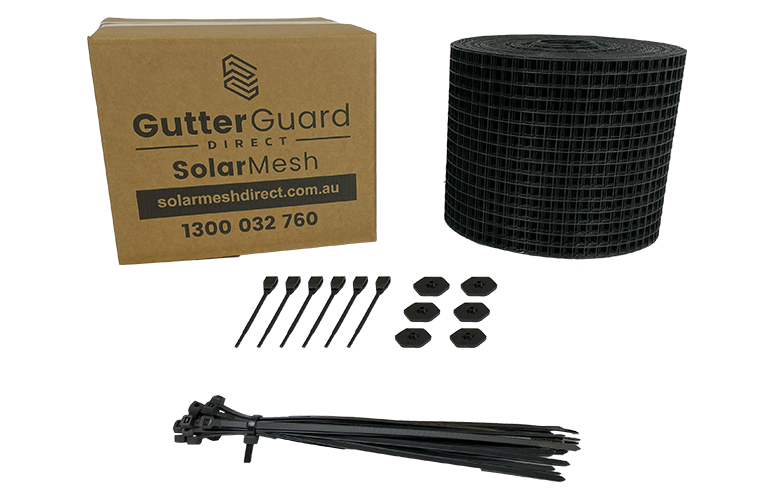
If you were buying mesh alone, 22 metres of galvanised mesh would cost about $38.50 and the same length of stainless steel 304 about $68.20. You'd then need clips as well, which are sold separately in the solar mesh clips collection, so check the total before assuming mesh-only is the cheaper route. The kit bundles the lot: 200mm wide mesh, 100 nylon clips and washers and 20 cable ties.
For comparison, published pricing guides put a professional install on a standard home at about $350 to $700. The point isn't that one is cheaper in every case. A professional price includes the roof work, any cleaning and someone else's judgement. A DIY price includes the mesh and your time.
The fitting process is straightforward on paper. You clip the mesh through to the inside lip of the panel, use the nylon washer to pull it tight, trim the excess clip, overlap and join the lengths, and work around the corners and mounts. Most people can fit solar mesh themselves on a safe, low roof. Be realistic about the roof, though. Working at heights is the real cost in a DIY job, and it doesn't show up on the invoice.
| Factor | DIY mesh kit | Professional install | Doing nothing |
|---|---|---|---|
| Upfront cost | Lowest of the active options | Higher, because labour is included | None |
| Ongoing cost | Low, with occasional checks | Low, with occasional checks | Repeated clean-outs and repairs |
| Pest access under panels | Closed off with mesh | Closed off with mesh | Open to birds, and rodents can follow |
| Roof access and safety | Your own risk | Handled by the installer | Ongoing exposure each time you clean |
| Warranty | Check the solar mesh warranty terms | Depends on the installer, get it in writing | Not applicable |
Doing nothing isn't free. A professional clean plus mesh job is commonly priced at about $500 to $900, which is a useful reference for what an established nest can cost you before any proofing even goes on. Droppings are corrosive too, and council guidance on feral pigeons recommends gloves, goggles and a mask for handling them.
On safety, Safe Work Australia says falls from height are the major cause of death and injury when working on roofs and advises treating every roof as fragile until a competent person says otherwise. If you're not comfortable, a quote is money well spent.

Measure the perimeter of your array, add a bit for corners and joins, and see which kit size covers it. You can check current pricing for the Solar Mesh Kit, or call us on 1300 032 760 if you'd like help working out how much mesh you need.
Once you know the budget, the next question is who does the work. Weigh up DIY against a professional honestly, and remember the DIY version is a clip and cable tie job rather than a specialist trade. If you're still choosing materials, the difference between galvanised and stainless steel mesh is worth understanding before you order. Current prices are listed with the solar mesh.
Mesh: Your corrugated roof Colorbond gutter guard kit comes with our durable Aluminium Gutter Guard Mesh. All kits are delivered in a gutter guard ...
View full detailsMesh: Your valley gutter guard kit for corrugated valleys comes with our durable aluminium mesh. It is delivered in roll form for easier installati...
View full detailsMesh: Your gutter guard for tiled roofs comes with our durable Aluminium Leaf Guard Mesh. It is delivered as a leaf guard mesh roll for easier inst...
View full detailsMesh: Your tiled roof valley guard kit for tiled roofs comes with our durable Aluminium Leaf Guard Mesh. Valley guard for tiled roofs is delivered ...
View full detailsMesh: Your Trimdek gutter guard kit comes with our durable Aluminium Gutter Mesh. All kits are delivered in a DIY gutter guard mesh roll for easier...
View full detailsFind answers to commonly asked questions below.